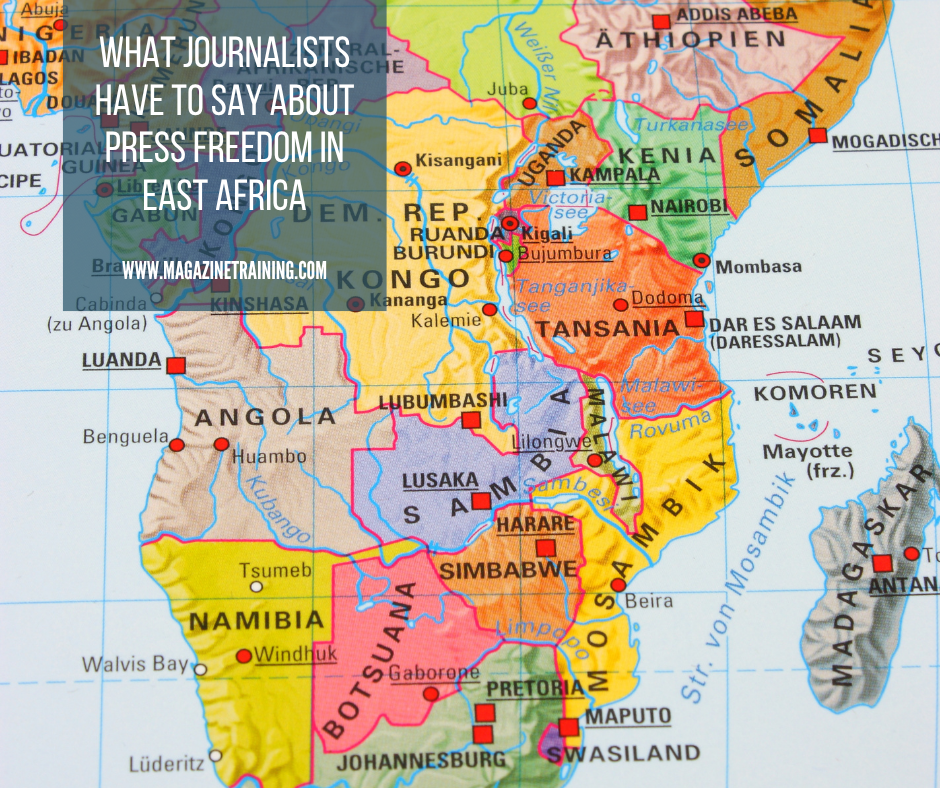
A majority of the world’s population has experienced a decline in press freedom in recent years, according to a U.N. report. In east Africa, the results are mixed and debatable.
In Rwanda, both international press freedom rankings and journalists on the ground say press freedom has increased over the past 10 years. In neighboring Uganda, both international rankings and local journalists say media freedom has declined. In Kenya, rankings reflect declining freedom over the past decade, but reporters acknowledge they have more freedom than their counterparts in Uganda and Rwanda.
In our roles as associate professors in journalism and mass communication, we interviewed and surveyed more than 500 journalists in Rwanda, Uganda and Kenya. We learned that the evolution and current state of press freedom in the region is complex. In our book, Press Freedom and the (Crooked) Path Toward Democracy: Lessons from Journalists in East Africa, we provide an updated state of press freedom in these three countries.
We argue that much of the academic research that classifies global media systems has overlooked the world’s most developing nations, and those that have included developing nations have failed to consider their historical contexts. They have worked from a misguided premise that nations develop in a linear fashion – from non-democracy to democracy – and from a restricted press to a free press. In reality, press freedom and democracy ebb and flow.
We examine the impact of social, political, legal and economic factors on media in Rwanda, Uganda and Kenya to help with understanding media systems outside the western world.
We chose to study these three countries because they represent varying stages of development and democracy building. Rwanda, which experienced a genocide in 1994, is in relatively early (though fast paced) stages of reconstruction. Uganda, which experienced a civil war in the 1980s and unrest in the 1990s but arguably not to the extent of Rwanda’s genocide, can be considered in a middle stage of development. Kenya, which has remained largely peaceful, can be understood as being in a more advanced stage of development.
Rwanda
In Rwanda, despite 30 years of economic, social and media progress and development, lingering impacts from the 1994 genocide against the Tutsi permeate the country’s media. Multiple laws limit free expression in the name of genocide prevention, and international press freedom rankings indicate the nation is not free.
Yet, we found that many Rwandan journalists believe that they have a great deal of freedom and that outsiders don’t consider the country’s history when evaluating the media. Outsiders, for example, hear that Rwandan journalists cannot criticize the president or high-ranking government officials and immediately think there is no press freedom. But local journalists say they don’t feel oppressed. They feel relatively free to choose their story topics. They don’t want to publish critical stories because they want to foster peace.
Journalists believe their role is to act as unifiers and right the wrongs of their predecessors who exacerbated the genocide. Public trust in the media remains high, according to focus groups conducted with members of the general public. In Rwanda, there appears to be a relationship between press freedom and distance from conflict. That is, the more time that passes since the country experienced war, the more press freedom it has.
Prioritizing social good over media rights has helped the country unify and develop, but over the long term we see signs that Rwanda’s linear path towards increasing democracy and press freedom may not continue. Rather, prioritizing peace at the cost of press freedom could limit development and reinforce existing authoritarian power structures.
Uganda
In Uganda, the relationship between press freedom and distance from conflict has been less linear. Some media restrictions have lessened and others have worsened.
by
Related posts
Magazine Training International’s mission is to encourage, strengthen, and provide training and resources to Christian magazine publishers as they seek to build the church and reach their societies for Christ.