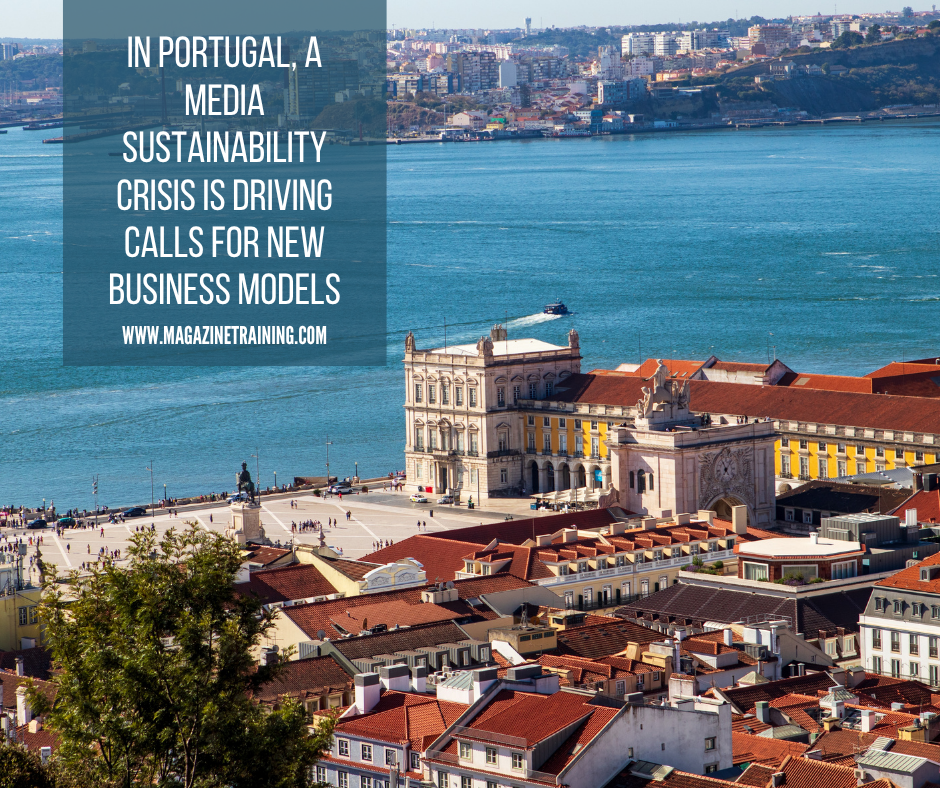
Triggered by a serious crisis in a media group, Portuguese journalists are starting to come together in search for solutions for the survival of journalism.
Recently, one of the largest media groups in Portugal, owning well-known newspapers and a radio, announced a contract cancellation program covering 200 workers, justifying with the need to counteract a complicated financial situation. There was even a delay of around 25 days in the payment of December’s salaries to the newspapers’ workers.
This was the moment when the country realized that no one really knows who owns Global Media Group (GMG). In September, 51% of the two companies holding 50.25% of GMG were sold to an investment fund based in the Bahamas, and it is completely unknown who the shareholder behind the fund is.
This case demonstrates that the current fragile business models in media entail risks of appearing as opaque economic interests, unavailable to comply with the purposes for which journalism serves.
There are historic newspapers in question at this time. One of the titles owned by GMG is Jornal de Notícias (JN), the only national generalist newspaper based in Porto – the second largest city in the country. With GMG’s management plan, 40 workers from this newspaper can leave, which would mean to cut the newsroom in half.
In the end, this situation has definitively revealed the crisis situation in the Portuguese media. “GMG is the tip of the iceberg,” said the president of the Portuguese Press Association at a TV debate, since the scenario is “dramatic” across the country. Cláudia Maia affirmed that 25% of the Portuguese counties (which means more than 70) are news deserts, that is, don’t have any journalistic outlets. This association has been trying to warn about this reality and has been meeting with political parties over many years, but Maia revealed that when it tried to meet with the current government it did not receive any response.
The perfect storm
Traditionally, Portugal is a country with a very low financial contribution from the state and civil society to journalism, with no structured incentives for the activity. Furthermore, many journalistic titles are grouped and owned by a small number of private conglomerations, often possessed by shareholders from various business areas like banking, real estate and tourism.
As a result of these and other factors, Portuguese journalism is going through a serious financial, labor and ethical crisis. Of the journalists interviewed in a recent Portuguese survey, 59% said that they have never received training from their employer, 48% have high levels of exhaustion, and for 52%, working conditions do not allow them to act with independence, integrity and security. As a Portuguese journalist said, “we have the perfect storm”: a crisis in the traditional financing model, difficulty in perceiving other financing possibilities, and a decreasing number of readers.
However, no one has paid attention to this problem in the last decades, not the political authorities, not even the journalists themselves. The Portuguese Congress of Journalists met again this year, in January, but it had not been held since 2017 and it was only the 5th edition since the first in 1983. Also, although it was already scheduled many months ago, the majority of the inflow was generated because of the recent case in GMG, as before it had almost no registrations.
This is because “the class is absolutely unconnected,” Pedro Coelho, the president of this congress’s organizing committee and award-winning investigative journalist, told The Fix. “Not even in newsrooms do we communicate things that have to do with our profession.” Now “we realize we’ve hit the bottom,” the profession itself is under threat, so the time has come for journalists to discuss together what the pillars of reconstruction should be, Coelho advocated.
Journalism is a public good
The discussion of new models that can support sustainable journalism in the future was, inevitably, one of the main topics under discussion at the congress. There is already a convergence of the need for public investment in journalism, even on the part of almost all political parties, now it is necessary to reach an agreement on concrete measures.
by
Related posts
Magazine Training International’s mission is to encourage, strengthen, and provide training and resources to Christian magazine publishers as they seek to build the church and reach their societies for Christ.