
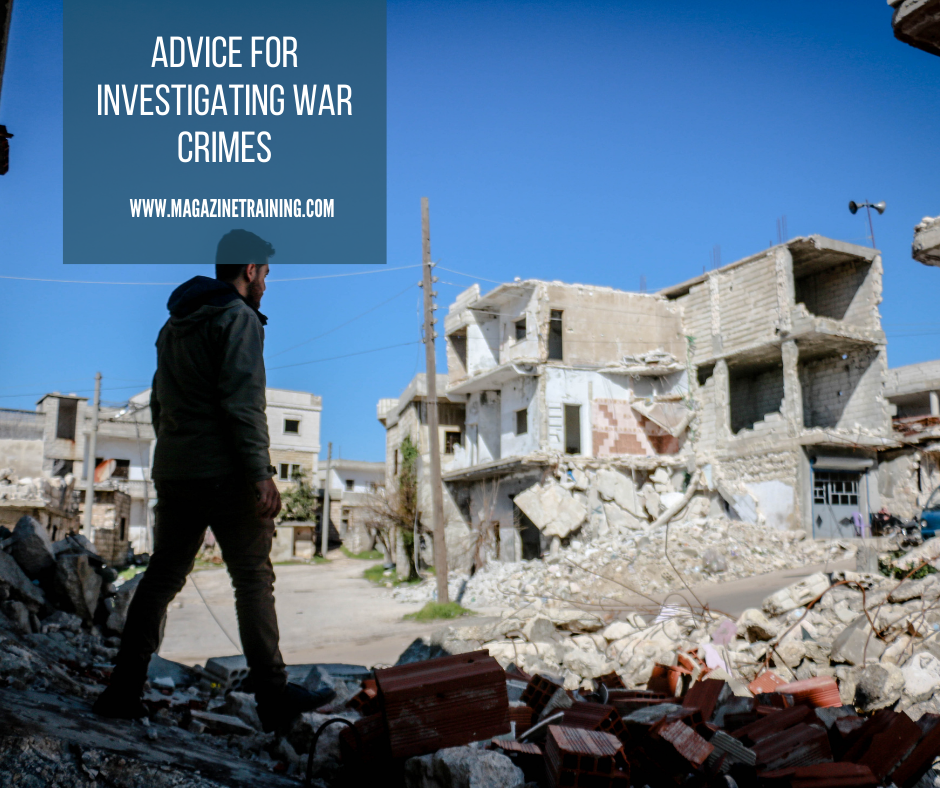
From the current atrocities being uncovered in Ukraine to the trials of criminals from the Bosnian war, journalism’s work of investigating war crimes is essential in making accountability possible. The split-second decision to take the photograph of an off-handed act of cruelty may later become the documentary evidence to take war criminals to court. Finding a Russian soldier’s discarded smartphone amongst the rubble might lead to identifying who gave orders to deport Ukrainian children from a village.
The 13th Global Investigative Journalism Conference’s (#GIJC23) panel “Investigating War Crimes,” moderated by Denis Džidić, executive director and editor of the Balkan Investigative Reporting Network in Bosnia and Herzegovina (BIRN BiH), featured Yanina Korniienko, Ukrainian journalist from Slidstvo.Info — an anti-corruption journalism platform that pivoted to war crime reporting after the Russian invasion — Nick Waters, Bellingcat’s digital investigator for the Syria, Yemen, and Ukraine conflicts, Sophia Jones, award-winning journalist and current war crimes and human rights violations investigator for Human Rights Watch, and Ron Haviv. Haviv is one of the world’s leading photojournalists and founder of VII Foundation, whose photographs have been the basis for proving war crimes in the Serbian war, as described in his upcoming documentary, “Biography of a Photo.”
Haviv, Džidić, and Waters also contributed to GIJN’s Reporter’s Guide to Investigating War Crimes, released earlier this month, in which more than a dozen veteran journalists and experts wrote on topics such as what is legal in war, conflict-related sexual violence, genocide, forced disappearances, and banned and restricted weapons.
Being familiar with international humanitarian law, knowing what is legal or not, and what weapons are banned and restricted was knowledge that Bellingcat’s Nick Waters insisted was essential. “It’s very important to at least understand the basic principles when you are trying to establish if illegal atrocities are being committed,” he said. “Even under these laws, pretty horrible things can happen which are entirely legal.”
This knowledge allows journalists to detect crucial nuances. For example, phosphorus as an incendiary weapon is legal, but when its toxic fumes are used in tunnels to kill enemies, it is considered a chemical weapon and is illegal. Being familiar with weaponry — like if certain rockets are very precise or not, which units use what kinds of artillery, and at what angle do certain shells fall — will give you information that might lead to uncovering if a given commander gave an order that constituted a war crime. And the most important tip shared by Waters, never disturb anything you find in a war zone that an explosives ordnance team hasn’t confirmed is safe. Or, as he more bluntly put it: “Don’t pick up stuff.”
By IJNET
Related posts
Magazine Training International’s mission is to encourage, strengthen, and provide training and resources to Christian magazine publishers as they seek to build the church and reach their societies for Christ.