
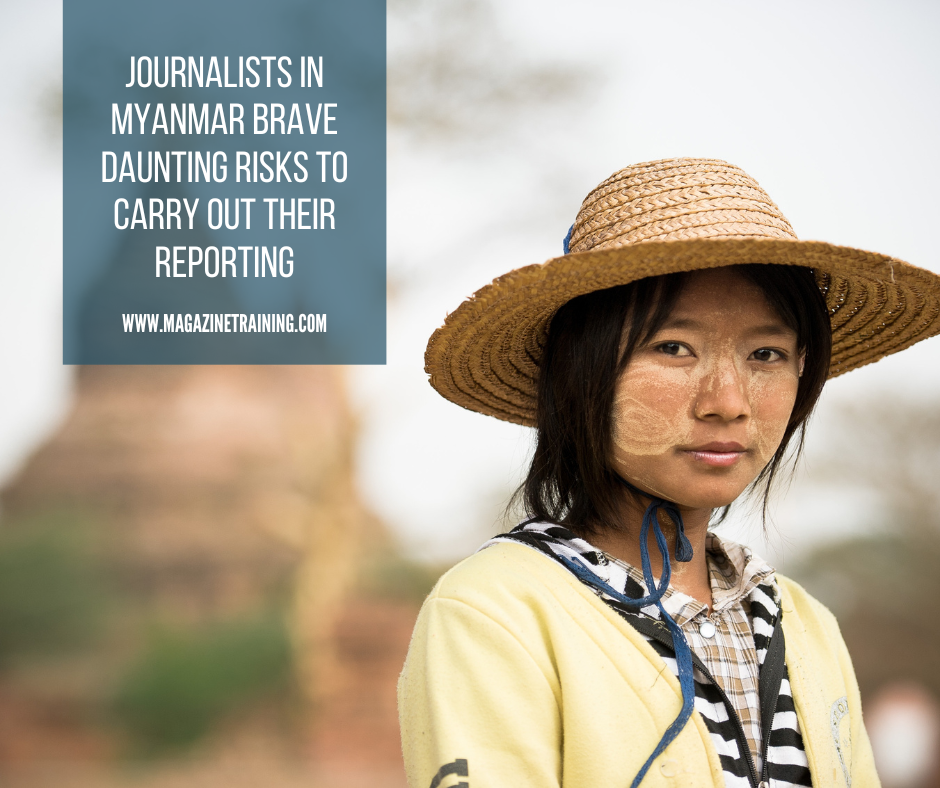
Myanmar’s military, also known as the Tatmadaw, overthrew the country’s democratically elected leader Aung San Suu Kyi in February 2021 over baseless claims of fraud in the previous general election. Soon after taking power, the military began raiding independent media offices and arresting journalists. To this day, journalists in Myanmar brave daunting risks to carry out their reporting.
Many have fled, and those who remain face threats to their safety. Today, Reporters without Borders estimates that 70 journalists are currently in prison in the country. Some who were released from prison have recounted stories of severe torture. At least four journalists have died at the hands of the military junta, including two while in custody.
Among those who have faced threats is freelance journalist Nyein Nyein Aye, who was sentenced to three years in prison with hard labor. Reporters Maung Maung Myo and Aung San Lin received six years in prison each, while photojournalist Aye Kyaw died in custody within 10 hours of his arrest in late July.
Despite these horrific risks, many journalists see reporting on the military’s violence as a means of resistance against the regime. These include Thang Deih Tuang, who wrote under the pseudonym Vahpual until he left Myanmar in June. “I wanted to utilize [my skills] to fight against the junta,” he said.
Logistical challenges
Among the most difficult challenges for journalists in Myanmar is the simple act of getting information out of the country. Unreliable electricity and internet complicate already risky tasks such as contacting sources, many of whom are afraid to speak with the media.
“[The military] cuts the electricity, for example, for eight hours per day. Sometimes we don’t know when they will cut electricity. We don’t have Wi-Fi connection, and [during periods of electricity cuts] we have to rely on mobile data,” said Tuang.
Yet mobile data is in short supply. In December 2021, the Tatmadaw ordered telecommunication companies to double the price of mobile data. The following month, the regime increased taxes on SIM card purchases and Wi-Fi services, in a continued attempt to restrict the flow of online dissent. A severe economic downturn caused by the coup has made the price hikes even more inaccessible.
Without electricity or Wi-Fi, the last resort to contact sources is via traditional phone lines, which pose the risk of being tapped.
“That’s very limiting … when you’re calling people living in conflict-affected areas. Basically, anything can be sensitive, even humanitarian issues at the moment, because they involve a conflict [of which] the military is a leading perpetrator,” said Emily Fishbein, an American freelance journalist covering Myanmar from outside the country. “The military is deliberately trying to cover up information through internet shutdowns.”
Searches and seizures
Transportation, restricted by military checkpoints where soldiers search phones and computers for evidence of anti-regime sentiment, is another hurdle. Officers arrested Myo after they searched his devices at a checkpoint and found articles he had written on his Facebook account.
In September 2021, Tuang was working on assignments from prominent international news organizations, but due to electricity outages he needed to travel to a different region to access the internet quickly. Before doing so, he deleted all of his contacts and his work from his phone and computer. “There was no choice, because if I [didn’t] delete them, I [would have gotten caught] at a checkpoint,” he said.
by
Related posts
Magazine Training International’s mission is to encourage, strengthen, and provide training and resources to Christian magazine publishers as they seek to build the church and reach their societies for Christ.